
Using WhatsApp chats as evidence in Indian courts has become increasingly common, transforming legal proceedings from civil disputes to criminal cases. As WhatsApp evolves from a personal chat app to a cornerstone of communication, a critical question arises for millions: are these WhatsApp chats as evidence are legally admissible? The answer, governed by strict laws like the Indian Evidence Act, is not a simple yes or no.
WhatsApp messages, like all other digital evidence, fall under the purview of Section 65B of the Indian Evidence Act, 1872. This law requires strict technical and procedural protocols, most notably the mandatory Section 65B certificate.
Author
Amritava Pramanik is a first-year B.A. LL.B. student at the Department of Law, University of Calcutta. Passionate about business law, corporate law, and legal research, Amritava enjoys exploring contemporary socio-legal issues through writing articles, participating in debates, and preparing case commentaries.
Edited by: Vikramaditya Buddhist
This article breaks down the legal framework and explains how to prove WhatsApp chats as evidence in court. We will analyze the pivotal role of the Section 65B certificate for WhatsApp chats and simplify the landmark judgments on electronic evidence that shape the law today. Whether you are a lawyer or an individual seeking legal knowledge, this guide will provide a clear understanding of how to use WhatsApp chats in a real-life legal context.
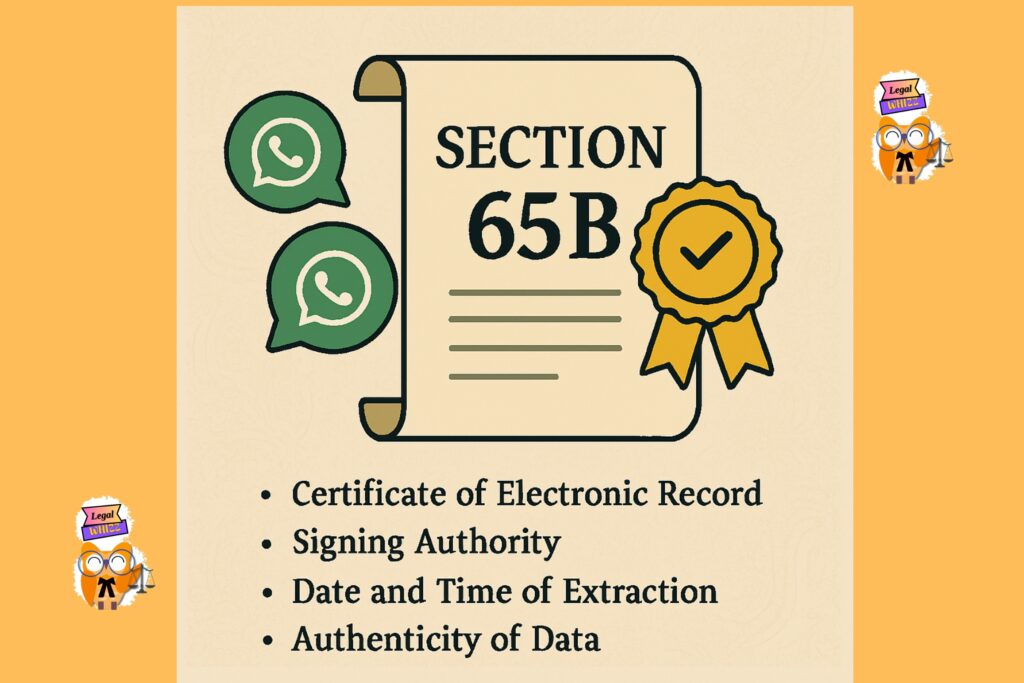
What is a Section 65B Certificate?
A Section 65B certificate is a formal declaration, not a complicated document. To be valid, it must include:
- A description of the electronic record: e.g., “A printout of a WhatsApp chat between John Doe and Jane Smith from July 15, 2025.”
- Details of the device: e.g., “The printout was produced from an Apple iPhone 15, serial number XXXXX.”
- A statement of authenticity: A declaration that the device was operating properly and the information is a true copy.
- Signature: It must be signed by a person in a position of responsibility over the device, like the phone’s owner.
What is the Legal Rule? Understanding Section 65B of the Evidence Act
Under the Indian Evidence Act, “electronic records” are defined broadly to include any information stored, recorded, or transmitted in digital form—which explicitly covers WhatsApp messages. Section 65B lays out the specific conditions for presenting such evidence in court.
The core rule is this: if you want to use a digital record (like a screenshot of a WhatsApp chat) without producing the original device in court, you must provide a Section 65B(4) certificate. This certificate is a formal document that must:
- Identify the electronic record (e.g., the specific chat or screenshot).
- Describe how it was produced (e.g., printed from a mobile phone).
- Provide details of the device used (e.g., the mobile phone’s make and model).
- Be signed by a person in a responsible official position who can vouch for the operation of the device.
This certification is the bedrock of proving the authenticity and integrity of digital evidence.
Feeling overwhelmed by the paperwork? Download our free, easy-to-use Section 65B Certificate template to ensure your evidence is compliant.
Key Supreme Court Judgments on use of WhatsApp Chats as Evidence in India
The law on electronic evidence in India has evolved through a series of key judgments. Here are the most important cases you need to know.
1. Anvar P.V. v. P.K. Basheer & Ors. (2014)1
This judgment confirmed that for WhatsApp chats as evidence to be valid, they require a robust legal foundation.
- Background: This landmark case involved the use of CDs with speeches and songs to prove “corrupt practices” during an election.
- Key Issue: Can an electronic record be admitted as evidence without the Section 65B certificate?
- Judgment: The Supreme Court unequivocally ruled that unless an electronic record is accompanied by a certificate under Section 65B(4), it is not admissible as evidence. This judgment established a rigid standard, making the certificate a sine qua non (an essential condition) for admitting digital evidence.2
- Significance: The Anvar P.V. ruling cemented the mandatory nature of the 65B certificate for all electronic records, including WhatsApp chats.
The Rule: This is the foundational case. The Supreme Court made it clear that an electronic record is inadmissible without a Section 65B certificate.The Bottom Line: No certificate = No evidence. This ruling established the mandatory nature of the certificate for all digital records, including WhatsApp chats.
2. Arjun Panditrao Khotkar v. Kailash Kushanrao Gorantyal (2019)
- Background: This election dispute case again centered on the admissibility of a video recording from an electronic device.
- Key Issue: Is the Section 65B certificate mandatory even when the original device is produced in court?
- Judgment: The three-judge bench reinforced the Anvar P.V. ruling. It held that the certificate is necessary for all electronic records unless the device’s owner is the one producing it and can personally testify to its authenticity in court.
- Significance: This decision resolved the remaining ambiguity from a previous judgment (Shafi Mohammad), confirming that strict procedural compliance is crucial for admissibility.3
3. Shafhi Mohammad v. The State of Himachal Pradesh (2018)4
- Background: In a murder investigation, video clips from third-party mobile phones were presented as evidence.
- Key Issue: What if a party cannot produce a Section 65B certificate because the device is not under their control?
- Judgment: The Court provided a slight relaxation of the Anvar rule. It stated that if a party is not in possession of the device, they can apply to the court to direct the owner to produce the certificate. The evidence would not be automatically dismissed just because the certificate was missing.
- Significance: This case remains relevant for situations where digital evidence is on a device owned by a third party.
4. Ambalal Sarabhai Enterprises Ltd. v. K.S. Infraspace LLP (2019)5
- Background: A commercial dispute involved using WhatsApp messages to prove the existence of a contract.
- Key Issue: Can WhatsApp messages prove a concluded contract?
- Judgment: The Supreme Court affirmed that WhatsApp messages are admissible but must be proven like any other electronic record—by authenticating the sender, recipient, and content, and by providing a Section 65B certificate. The court also clarified that blue ticks alone do not prove a contract was accepted.
- Significance: This judgment confirmed that while WhatsApp messages are a valid form of evidence, they still require a robust legal foundation to hold weight in court.
Using WhatsApp Chats as Evidence in Family Law Cases
The legal landscape for digital evidence can be less rigid in specific jurisdictions.
Deepti Kapur v. Kunal Julka (2020)6
- Background: A wife presented WhatsApp messages to prove harassment by her husband in a matrimonial dispute.
- Judgment: The Delhi High Court noted that Family Courts, under the Family Courts Act, 1984, are not bound by the strict rules of evidence. They can admit relevant WhatsApp chats even without formal proof if they are deemed relevant and trustworthy.
- Significance: This ruling makes it easier to use WhatsApp messages as evidence in family litigation, though their value still depends on corroboration from other evidence.
Madhya Pradesh High Court – June 2025 Ruling7
- Background: A husband used his wife’s private WhatsApp chats to argue for a divorce on grounds of mental cruelty. The wife claimed a violation of her privacy.
- Judgment: The MP High Court ruled that the right to privacy cannot override the right to a fair trial in matrimonial disputes. It stated that relevant material, even if collected without explicit consent, should not be rendered irrelevant if it helps prove a fact. However, the court mandated that the evidence must still be authenticated.
- Significance: This decision opens the door for using WhatsApp messages in divorce and cruelty cases, even if their collection raises privacy concerns, provided their authenticity is established.
How to Use WhatsApp Chats as Evidence: A Practical Guide
To ensure your WhatsApp evidence is admissible, follow these essential steps:
- Obtain a Section 65B Certificate: This is the most critical step. The certificate must be signed by the person who operated the device and produced the electronic record.
- Ensure Authenticity: Be prepared to prove that the chat is genuine and has not been tampered with.
- Provide Context: Present the chat within the broader context of the case. A single, isolated message may have limited value.
- Corroborate with Other Evidence: While compelling, a WhatsApp chat is often strongerA when it supports or is supported by other forms of evidence (e.g., bank statements, emails, or witness testimony).
Conclusion: Navigating the Future of Digital Evidence
The law on electronic evidence in India has matured significantly, balancing the need to incorporate modern technology with the principles of trial fairness and constitutional protections. While using WhatsApp chats as evidence can be compelling proof, they are not a silver bullet. They must be presented with care, integrity, and a full understanding of the law.
For Advocates, this means being vigilant in protecting client privacy while meeting the demands of a modern justice system. For individuals, it means understanding the rules of admissibility and the importance of a Section 65B certificate to ensure your digital evidence holds up in court. As digital communication becomes more integrated into our lives, a clear and prepared approach to handling WhatsApp chats as evidence will be more critical than ever.
Need Legal Help with Digital Evidence?
Presenting WhatsApp messages in court can be complex. If you are dealing with a legal issue and need to use digital evidence, it’s crucial to consult with a qualified legal professional. Contact a lawyer to ensure your evidence is handled correctly and your rights are protected.
- Anvar P.V. v. P.K. Basheer & Ors. 2014 10 SCC 473 ↩︎
- Aditya Mehta, Arjun Sreenivas & Swagata Ghosh, ‘Section 65B of the Indian Evidence Act, 1872: Requirements for admissibility of electronic evidence revisited by the Supreme Court’ (India Corporate Law, Cyril Amarchand Mangaldas blogs, 27 July 2020) <https://corporate.cyrilamarchandblogs.com/2020/07/section-65b-of-the-indian-evidence-act-1872-requirements-for-admissibility-of-electronic-evidence-revisited-by-the-supreme-court/> accessed 12 August 2025 ↩︎
- Adv. (Dr.) Prashant Mali, ‘Electronic Evidence in India: A Cyber Lawyer’s Perspective on Case Laws under IEA and BSA’ (CISO PLATFORM, 30 April 2025) <https://www.cisoplatform.com/profiles/blogs/electronic-evidence-in-india-a-cyber-lawyer-s-perspective-on-case>accessed 12 August 2025 ↩︎
- Shafhi Mohammad v. The State of Himachal Pradesh, [2018] 2018 (1) S.C.Cr.R. 473 ↩︎
- Ambalal Sarabhai Enterprises Ltd. v. K.S. Infraspace Llp, [2019] AIRONLINE 2019 SC 1170 ↩︎
- Deepti Kapur v. Kunal Julka [2020] AIR 2020 DELHI 156 ↩︎
- Anukriti Mishra, ‘MP High Court Allows Husband To Produce Wife’s WhatsApp Chats Obtained Without Her Consent To Prove Adultery Allegations’ (LiveLaw, 17 June 2025) <https://www.livelaw.in/high-court/madhya-pradesh-high-court/husband-sneaks-wifes-whatsapp-chat-extramarital-affair-adultery-right-to-privacy-fair-trial-295112>accessed 12 August 2025 ↩︎