
In a democratic society, the power to arrest is a necessary tool for law enforcement, but it is not absolute. The Indian legal system operates on the golden principle of “innocent until proven guilty.” To protect individual liberty against arbitrary state power, both the Constitution of India and the new Bharatiya Nagarik Suraksha Sanhita (BNSS), 2023, provide robust safeguards for arrested individuals.
Whether you are a law student, a legal professional, or a conscious citizen, understanding the rights of an arrested person is crucial. These rights are not just statutory privileges; they are fundamental protections rooted in human dignity and the rule of law.
This guide breaks down the essential rights of an arrested person in India, referencing the specific sections of the new BNSS and the relevant Constitutional Articles.
The Constitutional Shield: Fundamental Rights
Before diving into the procedural laws of the BNSS, it is vital to recognize that the rights of an accused form part of the “Magna Carta” of the Indian Constitution (Part III).
- Article 21: States that “No person shall be deprived of his life or personal liberty except according to procedure established by law.”
- Article 22: specifically deals with protection against arrest and detention in certain cases.
If these fundamental rights are violated, a writ petition can be filed directly in the Supreme Court (Article 32) or High Courts (Article 226) for immediate relief.
9 Essential Rights of an Arrested Person Under BNSS, 2023
The Bharatiya Nagarik Suraksha Sanhita (BNSS), 2023, which replaces the CrPC, explicitly codifies several rights to ensure fair treatment.
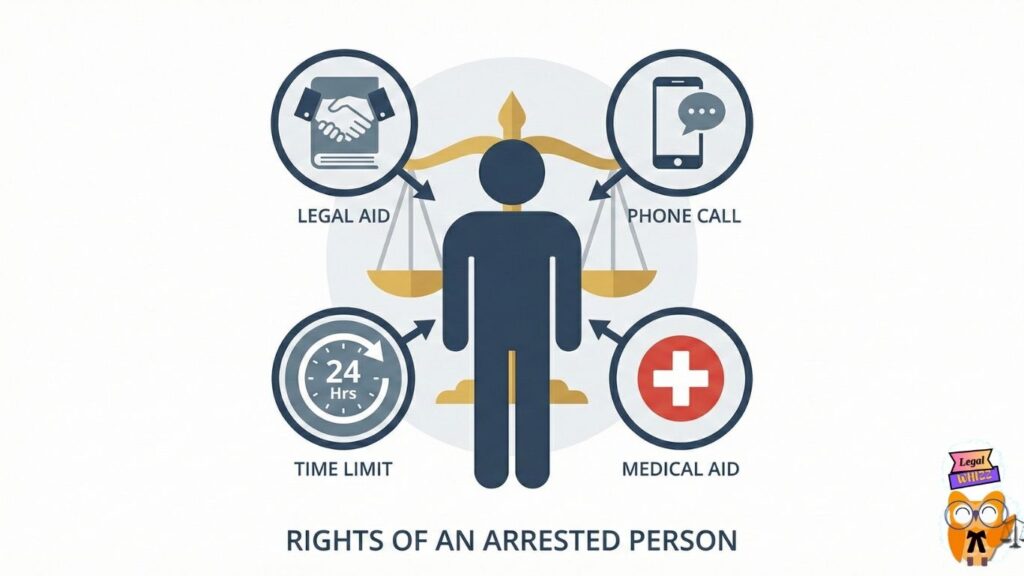
1. Right to Know the Grounds of Arrest
You cannot be arrested without knowing why.
- BNSS Section 47(1): Mandates that any police officer arresting a person without a warrant must immediately communicate the full particulars of the offense and the grounds for the arrest.
- Constitutional Backing: Article 22(1) mirrors this, stating no person shall be detained without being informed of the grounds for such arrest.
- Subordinates & Warrants: Even if a subordinate officer makes the arrest (Section 55) or if a warrant is executed (Section 77), the substance of the order or warrant must be notified to the accused.
2. Right to Inform a Friend or Relative
The police cannot keep an arrest a secret.
- BNSS Section 36(c) & 48(1): The police are legally obligated to inform a friend, relative, or any person nominated by the arrested person about the arrest and the place where they are being held. This must be done immediately upon arrest.
3. Right to Be Produced Before a Magistrate (24 Hours)
This is the most critical check against police excesses.
- BNSS Section 57 & 58: A police officer cannot detain an arrested person for more than 24 hours without a special order from a Magistrate.
- Calculation: The 24-hour period excludes the time necessary for the journey from the place of arrest to the Magistrate’s court.
- Consequence: If the police fail to produce the accused within this timeframe, the detention becomes illegal (Section 58). This aligns perfectly with Article 22(2) of the Constitution.
4. Right to Bail Information
- BNSS Section 47(2): If a person is arrested for a bailable offense without a warrant, the police officer must inform them that they are entitled to be released on bail and permit them to arrange for sureties. Ignorance of the law should not keep a person behind bars for a bailable crime.
5. Right to Legal Representation
- BNSS Section 38: An arrested person has the right to meet an advocate of their choice during the interrogation, though not necessarily throughout the entire interrogation.
- Constitutional Mandate: Article 22(1) guarantees the right to consult and be defended by a legal practitioner of one’s choice.
6. Right to Free Legal Aid
Justice should not be denied due to poverty.
- BNSS Section 341: If an accused in a Sessions Court trial does not have a lawyer and cannot afford one, the court must assign a pleader for their defense at the expense of the State.
- Landmark Judgments:
- Khatri v. State of Bihar (1981): The Supreme Court held that the state is under a constitutional mandate (Article 39A) to provide free legal aid. This right begins from the moment the accused is first produced before the Magistrate.
- Suk Das v. UT of Arunachal Pradesh (1986): The court ruled that even if the accused does not apply for it, legal aid must be provided. Failure to do so vitiates the trial.
7. Right to a Fair and Speedy Trial
While not explicitly defined in a single section of the BNSS, the concept of a fair trial is the soul of criminal jurisprudence.
- Article 14: Ensures equality before the law.
- Speedy Trial: In Hussainara Khatoon v. Home Secretary, State of Bihar (1979), the Supreme Court declared that the right to a speedy trial is an integral part of Article 21.
8. Right to Remain Silent (Protection Against Self-Incrimination)
- Article 20(3): “No person accused of any offense shall be compelled to be a witness against himself.”
- Nandini Satpathy Case: The Supreme Court in Nandini Satpathy v. P.L. Dani (1978) ruled that an accused has the right to remain silent during interrogation if the answers would be self-incriminatory.
9. Right to Medical Examination
The BNSS provides specific provisions for the health and examination of the accused:
- BNSS Section 53: Every arrested person must be examined by a medical officer soon after arrest. If it is a female arrestee, the examination must be done by a female doctor.
- BNSS Section 51: While the police can request a medical exam to gather evidence, Section 56 puts a duty on the person having custody to take reasonable care of the health and safety of the accused.
Special Protections and Procedures
Beyond the core rights, the BNSS outlines specific protocols to ensure dignity:

- Women’s Rights (Section 43): A woman generally cannot be arrested after sunset and before sunrise. If exceptional circumstances exist, a woman police officer must obtain prior permission from a Judicial Magistrate First Class. Furthermore, a police officer strictly cannot touch the person of a woman while making an arrest.
- No Unnecessary Restraint (Section 46): An arrested person should not be subjected to more restraint (like handcuffs) than is necessary to prevent their escape.
- Compensation for Groundless Arrest (Section 399): The law provides for compensation to persons who have been arrested on groundless charges, protecting citizens from malicious prosecution.
Do you know: Whether Administrative Orders Fall Under Article 13(3)(a)? Click here to learn.
Conclusion
The rights of an arrested person serve as the intersection between individual liberty and state authority. The Bharatiya Nagarik Suraksha Sanhita, 2023, alongside the Constitution, ensures that the power of arrest is not used as a tool for oppression.
From the right to remain silent to the right to legal aid, these provisions make procedural fairness a constitutional necessity. However, the existence of laws is not enough; awareness and active enforcement are required to ensure that the dignity of every individual—accused or otherwise—is upheld.
Key Takeaways
- 24-Hour Rule: Police must produce an arrested person before a Magistrate within 24 hours (excluding travel time).
- Information is Power: The accused must be informed of the grounds of arrest and their right to bail (for bailable offenses).
- Legal Aid is a Right: Lack of funds cannot be a reason for lack of defense. The state must provide a lawyer if the accused is indigent.
- Women’s Safety: Strict rules restrict the arrest of women between sunset and sunrise.
Did you find this guide helpful? Understanding your rights is the first step toward justice. Share this article to spread legal awareness.