
Intellectual Property Rights in E-Commerce: Role, Types & WIPO Standards
Abstract – “Intellectual property rights refer to the property rights which are granted to an author or creator of a new invention or intangible asset. The concept of intellectual property was developed in the 18th century, with the first federal statute on patents being passed in 1790. Intellectual property rights are the legal protection granted to individuals who have invented something new or created something original that is capable of being physically reproduced or transmitted. The scope of intellectual property rights varies from country to country, but generally any form of expression that falls within the jurisdiction of copyright law and patent law is protected as intellectual property (see section 20(1)(b) of the Copyright Act 1957). More than other business models, e-commerce frequently involves the sale of goods and services that are dependent on IP and its licensing. Through e-commerce, you may exchange things like software, designs, training materials, systems, and more, with the IP serving as the major source of value. Because valuable commodities traded online must be safeguarded by technological security measures and IP laws, or entire firms risk being ruined by theft or piracy. This paper studies the history of IPR, Its types and role of IPR in e- commerce. The protection for any creative work such as music, text, software code, graphic design etc. cannot be revoked by anyone at all as it is not owned by anyone in particular. IP rights protect intellectual property in a wide variety of ways, covering protection of inventions and designs, protection for data and software, as well as protection for literary material like books and films. IP plays a role in facilitating smoother E-Commerce transactions.”
Table of Contents
- INTRODUCTION
- HISTORY OF INTELLECTUAL PROPERTY RIGHTS
- THREE MAIN TYPES OF IPR
- INTELLECTUAL PROPERTY RIGHTS AND ITS ROLE IN E-COMMERCE
- ELEMENTS PROTECTED UNDER IPR IN E-COMMERCE
- INTERNATIONAL REGIME OF INTELLECTUAL PROPERTY RIGHTS
- WORLD INTELLECTUAL PROPERTY ORGANISATION (WIPO)
- THE ROLE OF PATENT COOPERATION TREATY
- Management of Intellectual Property in Pharmaceutical Industries
- CONCLUSION
- REFERENCES
About Author
As an enrolled Advocate (Bar Council of Uttarakhand) and Legal Researcher at Legal Whizz, Arbaz Alam specializes in making complex Taxation and Civil Law matters understandable. He leverages his practical background—which includes assisting senior counsel in the High Court and drafting everything from petitions to contracts—to conduct deep-dive research into Supreme Court judgments and legislative amendments. Arbaz’s primary focus is translating this rigorous analysis into simplified, engaging content that keeps readers informed.
INTRODUCTION

Intellectual property1 (IP) is the term used to describe exclusive rights pertaining to creative works. Intangible assets including innovations, literary and artistic works, designs, phrases, symbols, and images can be protected under IP law. This protection is made possible by various IP rights, including patents, trademarks, designs, and copyright (for more information, see the section “Types of Intellectual Property Protection Rights”). These rights allow their owners to profit financially or gain recognition from their inventions or creations Electronic commerce, or simply E- commerce, is the practice of conducting business dealings online. Among them would be starting or running a business, trading products and services, or both, primarily online. Ecommerce platforms like Amazon, Swiggy, Zomato, and others might serve as examples. E-commerce often entails the sale of goods or services based on licensed intellectual property. Music, photos, graphics, software, content, and so many other sorts of intellectual property can all be transferred through an e-commerce platform in the domain of digital goods. IPR is extremely critical in each of these situations since it’s important to safeguard the items’ worth. Tools like intellectual property laws and technology security measures are used to provide the protection. IPR in e-commerce is particularly important since IP theft can potentially kill an online firm if it is prevalent.
HISTORY OF INTELLECTUAL PROPERTY RIGHTS
Origin of Patents, Copyright and Trademark.
Origin and History of Patents Origin in India:
The Act VI of 1856 was the country’s first piece of law pertaining to patents. The goal was to promote inventions and get innovators to divulge their inventions’ secrets. Act XV of 1859, a new piece of legislation, was afterwards introduced to provide exclusive privilege. The measure was renamed The Patterns and Designs Protection Act in 1872, nevertheless. The 1883 amendment was the only change made to the law during its 30-year lifespan. All prior laws in India were repealed by the Indian Patents and Design Act. This act created provisions for the granting of secret patents, patents for additions, and extending the duration of a patent from 14 to 16 years. Following independence, several committees were established to look at the changes to the law, and as a result, a bill was tabled in the Lok Sabha in 1965 but failed to pass. Although it expired in 1965, a revised measure was filed in 1967, and on the committee’s final suggestion, the Patents Act, 19702, which is currently in use in India, was enacted.
Origin and History of Copyright:
In India, copyright law was first established in 1847 as a result of an East India Company-era ordinance. The copyright’s term at the time was 42 years + 7 years post-mortem. If the copyright holder refused to allow the publication of a work after the author’s passing, the government might issue a compulsory licence. In order to enforce rights under this act, copyright registration was required. Under the British Raj, the Indian government of the time passed a new copyright law in 1914 that was remarkably similar to the United Kingdom Copyright Act of 1911. There weren’t many significant differences, though. The most significant one is that it created sections 7 to 12 that established criminal penalties for copyright infringement. The 1911 Act was changed numerous times up to 1957, and as a result, independent India passed the Copyright Act that year in order to comply with the Berne Convention’s rules. The most recent modification to the 1957 Act was made in 2012.
Origin and History of Trademark:
The Trademark Act of 1940, which was adapted from the British Trademark Act of 1938, was the first trademark-related law in India. The Trade and Merchandise Act, 1958 was also passed after independence. Numerous changes were made up until December 30, 1999, when the Trade Mark Act, 19993, which is currently in effect in India, was established. The two main needs met by this act are to: a) shield the owner from chaos and competitor mark duplication. b) protect the company, commerce, and goodwill that the trademark owner has built up.
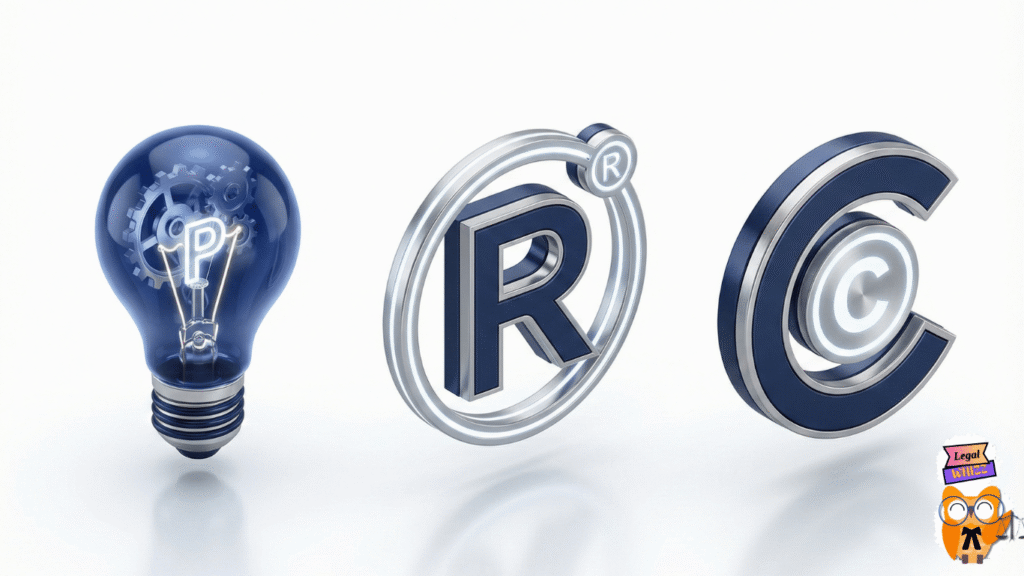
THREE MAIN TYPES OF IPR
PATENTS:
Researchers and inventors in the field of e-commerce and online enterprises receive a lot of incentives from patents. Patents facilitate licencing, outsourcing agreements, and the development of tactical alliances in ecommerce. Patents not only assist in capturing and creating new ideas for an E-Commerce business, but they also increase the sales of your items by granting them special qualities that set them apart from other online competitors. One of the most significant forms of IPR is the patent. A government authorization or licence that grants a right or title for a specific time period, particularly the exclusive right to prevent others from creating, utilising, or selling an invention, is what is meant by this definition. When individuals or organisations create new products or processes, they go to the patent office, describe the invention in detail, and pay a fee to have their “property” protected.
COPYRIGHTS:
Copyrights are crucial in the current digital era for protecting the information and creative work on websites. Because of the fast digitization, the owners of the copyrights seek copyright protection to stop any illicit distribution or copying of their works that are displayed online. Additionally, a variety of technological safeguards, including encryption and watermarking, can be employed to protect the intellectual property rights of online enterprises. Copyright describes the rights given to authors, painters, musicians, and other creators for their “original” works of creativity or to performers, artists, and broadcasters for the associated rights. Copyright regulations are monopolistic rights just like patent laws. Any literary, musical, dramatic, artistic, or architectural work created by the author is granted the exclusive right to be sold, published, and reproduced.
TRADEMARKS:
Trademarks are extremely important in the internet world and e- commerce to develop a brand image by expanding or selling the enterprises. A registered trademark also makes it simpler to file lawsuits and initiate legal processes against companies that online infringe on your company’s intellectual property. A trademark is a recognisable symbol that aids consumers in determining the source of specific goods or services. It can take the shape of text, words, numbers, phrases, symbols, designs, smells, colours, shapes, sounds, packaging, textures, or any combination of these things. The purpose of a distinctive trademark is to enable consumers to connect a certain mark with a particular manufacturer of goods or service provider in the case of services. It aids in assuring the clients that the products are of a particular type and quality.
Other types of Intellectual Properties
TRADE SECRET:
Trade secrets are an important aspect of IPR law. As the name suggests, it refers to the secrets of a business, which helps it gain an economic advantage over others. In case the trade secret is leaked, the business may suffer numerous losses and irreparable damage to reputation. Trade secrets can be in the form of confidential information, data, formula, composition, process, design, method or compilation or combination of one or more, which should remain with the business alone.
GEOGRAPHICAL INDICATIONS:
A geographical indication (GI) is a sign used on products that have a specific geographical origin and possess qualities or a reputation that are due to that origin. In order to function as a GI, a sign must identify a product as originating in a given place.
A geographical indication right enables those who have the right to use the indication to prevent its use by a third party whose product does not conform to the applicable standards. For example, in the jurisdictions in which the Darjeeling geographical indication is protected, producers of Darjeeling tea can exclude use of the term “Darjeeling” for tea not grown in their tea gardens or not produced according to the standards set out in the code of practice for the geographical indication.
INTELLECTUAL PROPERTY RIGHTS AND ITS ROLE IN E-COMMERCE

Understanding the function of intellectual property in e-commerce is more crucial than ever thanks to ongoing advancements in the internet’s technological infrastructure. IPR can be used in e-commerce in four different ways:
1) Protecting a company’s business interests
In essence, intellectual property laws protect a company’s and its entities’ business interests from unfair competition. Particularly in this digital economy, the absence of IP practices and rules can lead to a number of IPR infractions. As a result, everything from software to design to music could be stolen, copied, and distributed everywhere, and the creators may not be compensated for their original works. However, businesses can protect their rights through rules governing IPR in e-commerce.
2) Protecting vital components
A company’s vital digital and technical assets are protected by intellectual property law in e-commerce. These could include networks, routers, plans, applications, processors, and other things. These elements are all distinct types of intellectual property that need to be protected in order for the internet to work properly. IPR in e- commerce also protects crucial elements with this in mind.
3) Safeguarding goods and obtaining patent permits
Patent and product licencing is the normal foundation for all online and e-commerce firms. The majority of internet businesses opt to outsource the creation of a few components or share their technologies through licence agreements because it requires numerous different technologies to generate a single product. The agreement is basically a set of rules and guidelines for IPR protection.
4) Preserving patent and trademark holdings
The most important asset for a company operating in the e-commerce industry is intellectual property. A portfolio of patents and trademarks that they normally possess adds to their company’s value. Thus, these patents, portfolios, and trademarks are protected by IPR rules in e-commerce. Although it has the biggest value-bearing component in E-Commerce, Intellectual Property (IP) is arguably the most undervalued, either because it isn’t well understood or because its significance in relation to ECommerce isn’t readily apparent. More than any other platform, e-commerce frequently involves the sale of products and services that are based on intellectual property and its licencing. Online firms should therefore make earnest efforts to guarantee that their operations are free of IP hazards that could hinder or even endanger their operations.
ELEMENTS PROTECTED UNDER IPR IN E-COMMERCE
IPR in retail and e-commerce pertains to the purchasing and selling of goods via a physical store and an online store, respectively. Owners of retail and online businesses must therefore safeguard a variety of intellectual properties. The items listed below are those that IPR in E-commerce covers under various models and legislation.
Search engines, e-commerce platforms, and other crucial online technologies are covered by patents and utility models. Depending on the country’s IPR rules, specific software, including the text-based HTML code used by websites, is protected under the Patent Law or the Copyrights Act. An e-commerce website’s entire design is likewise shielded by copyright laws. The Copyright Law protects all of the information on the website, including any written or visual materials, films, images, or other graphics. Companies can use copyright laws or country-specific database legislation to protect their databases under e-commerce in IPR. Companies can use the Trademark Law to protect their brand names, product names, logos, domain names, and other similar identifying indications posted on their websites with reference to both IPR in retail and e-commerce. Under the appropriate Industrial Design Law in their nation, businesses are also allowed to protect their computer- generated displays, graphic signals, webpages, and graphical user interfaces.
Websites frequently contain a number of hidden components that are protected by various trade secret laws, including secret visuals, object and source codes, algorithms, and programmes, technical descriptions, logic and data flow charts, user manuals, and the contents of their databases.
INTERNATIONAL REGIME OF INTELLECTUAL PROPERTY RIGHTS
Various agreements and conventions have been formulated at the international level to govern and regulate the various aspects and emerging issues relating to intellectual property rights. Some of the major efforts undertaken in the form of major international instruments, treaties, conventions, and forums dealing with intellectual property rights are as follows:

The Paris Convention on the Protection of Industrial Property:
The Paris Convention on the Protection of Industrial Property adopted in 1883 is the oldest international convention and was the first major step taken towards the protection of IP rights. The Convention contains 30 Articles dealing with various aspects and types of industrial property including patents, trademarks, service marks, utility models, industrial designs, geographical indications, and the repression of unfair competition. The Convention was revised in July 1967 in Stockholm.
The Convention is based on three guiding principles:
- National treatment: Each contracting state must provide the same level of protection to nationals of other contracting states as it grants to its own nationals.
- Right of priority: The Convention provides for the right of priority in the case of patents and utility models, marks and industrial designs. This right means that the applicant may, within a certain period of filing a regular first application in one of the contracting states, apply for protection in any of the other contracting states as well. The subsequent applications filed within the grace period shall be regarded as being filed on the same date as the first application. The benefit of this provision is that applicants seeking protection in several countries need not present all of their applications at the same time and have a period of 6/12 months to decide in which countries they wish to seek protection.
- Uniform rules: The Convention lays down some common rules that must be followed by all member states such as:
Patents granted in different contracting states for the same invention are independent of each other and the inventor has the right to be named as such in the patent.
Industrial designs must be protected in each contracting state, and protection may not be forfeited on the ground that articles incorporating the design are not manufactured in that State.
Protection must be granted to trade names in each contracting state without there being an obligation to file or register the names.
Patent Co-operation Treaty, 1970:
The Patent Co-operation Treaty (PCT) was concluded on 19th June, 1970 and came into effect on 24th January, 1978. The treaty aims to simplify the procedure of filing patent applications in states that are party to the treaty agreement. It provides a system for filing a patent application and entitles the nationals of a contracting state to obtain patents in multiple countries around the world on the basis of a single patent application.
Berne Convention for Protection of Literary and Artistic Works, 1886
The Berne Convention for Protection of Literary and Artistic Works adopted in 1886 is the most significant International Convention dealing with copyright protection. It provides for a minimum term of protection of copyright i.e. life of the author plus 50 years or an alternative of 50 years from the publication of anonymous and pseudonymous works. The Convention is based on three basic principles:
- Principle of national treatment: The works originating in one member state must be given the same protection in each of the other member states as the latter grants to the works of its own nationals.
- Principle of automatic protection: Protection should not be conditional upon compliance with any formality. This means that the original artistic and literary works shall be given automatic global protection from the moment of their creation, in a fixed medium, thereby ensuring equal treatment to such works.
- Principle of “independence” of protection: This means that the protection is independent of whether the protection exists in the country of origin of the work or not.
Universal Copyright Convention, 1952
Universal Copyright Convention (UCC) was developed under the auspices of the United Nations Educational, Scientific and Cultural Organisation (UNESCO) as an alternative to the Berne Convention of 1886. The Convention came into force in 1955. The Convention is based on the principle of national treatment and also requires each contracting state to maintain specific minimum legal safeguards protection of copyright. The Convention prescribes that the formalities required by the national law of a contracting state shall be considered to be satisfied if all the copies of a work originating in another contracting state carry the symbol ©, accompanied by the name of the copyright owner and the year of first publication.
WIPO Copyright Treaty, 1996
The WIPO Copyright Treaty (WCT) is a special agreement under the Berne Convention providing for the protection of works and the rights of their authors in the digital environment. According to the treaty, the works/subject matter protected by copyright include:
- Computer programs; and
- Databases i.e. compilations of data or other material, in any form constituting intellectual creations.
WORLD INTELLECTUAL PROPERTY ORGANISATION (WIPO)
Established on 14th July 1967, WIPO is a global forum for intellectual property (IP) services, policies, information, and cooperation. It aims to develop an effective and balanced international IP system that encourages innovation and creativity for the benefit of all. WIPO has 193 member states.
Objectives of WIPO
- Promoting intellectual property protection around the world through state cooperation and partnership with any international organisation;
- Harmonising national intellectual property legislations and procedures;
- To provide services with regard to international applications for intellectual property rights;
- For exchanging information on intellectual property;
- To provide legal and technical assistance concerning IP to developing and other countries;
- Facilitating resolution of private intellectual property disputes;
- Marshal information technology is a tool for storing, accessing and using valuable intellectual property information.
THE ROLE OF PATENT COOPERATION TREATY
The patent cooperation treaty (PCT) is a multilateral treaty entered into force in 1978. Through PCT, an inventor of a member country contracting state of PCT can
simultaneously obtain priority for his/her invention in all or any of the member countries, without having to file a separate application in the countries of interest, by designating them in the PCT application. All activities related to PCT are coordinated by the world intellectual property organization (WIPO) situated in Geneva.
In order to protect invention in other countries, it is required to file an independent patent application in each country of interest; in some cases, within a stipulated time to obtain priority in these countries. This would entail a large investment, within a short time, to meet costs towards filing fees, translation, attorney charges, etc. In addition, it is assumed that due to the short time available for making the decision on whether to file a patent application in a country or not, may not be well founded. Inventors of contracting states of PCT on the other hand can simultaneously obtain priority for their inventions without having to file separate application in the countries of interest; thus, saving the initial investments towards filing fees, translation, etc. In addition, the system provides much longer time for filing patent application in the member countries.
The time available under Paris convention for securing priority in other countries is 12 months from the date of initial filing. Under the PCT, the time available could be as much as minimum 20 and maximum 31 months. Further, an inventor is also benefited by the search report prepared under the PCT system to be sure that the claimed invention is novel. The inventor could also opt for preliminary examination before filing in other countries to be doubly sure about the patentability of the invention.
Management of Intellectual Property in Pharmaceutical Industries
More than any other technological area, drugs and pharmaceuticals match the description of globalization and need to have a strong IP system most closely. Knowing that the cost of introducing a new drug into the market may cost a company anywhere between $ 300 million to $1000 million along with all the associated risks at the developmental stage, no company will like to risk its IP becoming a public property without adequate returns. Creating, obtaining, protecting, and managing IP must become a corporate activity in the same manner as the raising of resources and funds. The knowledge revolution, which we are sure to witness, will demand a special pedestal for IP and treatment in the overall decision-making process.
Competition in the global pharmaceutical industry is driven by scientific knowledge rather than manufacturing know-how and a company’s success will be largely dependent on its R&D efforts. Therefore, investments in R&D in the drug industry are very high as a percentage of total sales; reports suggest that it could be as much as 15% of the sale. One of the key issues in this industry is the management of innovative risks while one strives to gain a competitive advantage over rival organizations. There is high cost attached to the risk of failure in pharmaceutical R&D with the development of potential medicines that are unable to meet the stringent safety standards, being terminated, sometimes after many years of investment. For those medicines that do clear development hurdles, it takes about 8-10 years from the date when the compound was first synthesized. As product patents emerge as the main tools for protecting IP, the drug companies will have to shift their focus of R&D from development of new processes for producing known drugs towards development of a new drug molecule and new chemical entity (NCE). During the 1980s, after a period of successfully treating many diseases of short-term duration, the R&D focus shifted to long duration (chronic) diseases. While looking for the global market, one has to ensure that requirements different regulatory authorities must be satisfied.
It is understood that the documents to be submitted to regulatory authorities have almost tripled in the last ten years. In addition, regulatory authorities now take much longer to approve a new drug. Consequently, the period of patent protection is reduced, resulting in the need of putting in extra efforts to earn enough profits. The situation may be more severe in the case of drugs developed through the biotechnology route especially those involving utilization of genes. It is likely that the industrialized world would soon start canvassing for longer protection for drugs. It is also possible that many governments would exercise more and more price control to meet public goals. This would on one hand emphasize the need for reduced cost of drug development, production, and marketing, and on the other hand, necessitate planning for lower profit margins so as to recover costs over a longer period. It is thus obvious that the drug industry has to wade through many conflicting requirements. Many different strategies have been evolved during the last 10 to 15 years for cost containment and trade advantage. Some of these are out sourcing of R&D activity, forming R&D partnerships and establishing strategic alliances.
Nature of Pharmaceutical Industry
The race to unlock the secrets of human genome has produced an explosion of scientific knowledge and spurred the development of new technologies that are altering the economics of drug development. Biopharmaceuticals are likely to enjoy a special place and the ultimate goal will be to have personalized medicines, as everyone will have their own genome mapped and stored in a chip. Doctors will look at the information in the chip(s) and prescribe accordingly. The important IP issue associated would be the protection of such databases of personal information. Biotechnologically developed drugs will find more and more entry into the market. The protection procedure for such drug will be a little different from those conventional drugs, which are not biotechnologically developed. Microbial strains used for developing a drug or vaccine needs to be specified in the patent document. If the strain is already known and reported in the literature usually consulted by scientists, then the situation is simple. However, many new strains are discovered and developed continuously and these are deposited with International depository authorities under the Budapest Treaty. While doing a novelty search, the databases of these depositories should also be consulted. Companies do not usually go for publishing their work, but it is good to make it a practice not to disclose the invention through publications or seminars until a patent application has been filed.
While dealing with microbiological inventions, it is essential to deposit the strain in one of the recognized depositories who would give a registration number to the strain which should be quoted in the patent specification. This obviates the need of describing a life form on paper. Depositing a strain also costs money, but this is not much if one is not dealing with, for example cell lines. Further, for inventions involving genes, gene expression, DNA, and RNA, the sequences also have to be described in the patent specification as has been seen in the past. The alliances could be for many different objectives such as for sharing R&D expertise and facilities, utilizing marketing networks and sharing production facilities. While entering into an R&D alliance, it is always advisable to enter into a formal agreement covering issues like ownership of IP in different countries, sharing of costs of obtaining and maintaining IP and revenue accruing from it, methods of keeping trade secrets, accounting for IP of each company before the alliance and IP created during the project but not addressed in the plan, dispute settlements. It must be remembered that an alliance would be favorable if the IP portfolio is stronger than that of concerned partner. There could be many other elements of this agreement. Many drug companies will soon use the services of academic institutions, private R&D agencies, R&D institutions under government in India and abroad by way of contract research. All the above aspects mentioned above will be useful. Special attention will have to be paid towards maintaining confidentiality of research.
The current state of the pharmaceutical industry indicates that IPR are being unjustifiably strengthened and abused at the expense of competition and consumer welfare. The lack of risk and innovation on the part of the drug industry underscores the inequity that is occurring at the expense of public good. It is an unfairness that cannot be cured by legislative reform alone. While congressional efforts to close loopholes in current statutes, along with new legislation to curtail additionally unfavorable business practices of the pharmaceutical industry, may provide some mitigation, antitrust law must appropriately step in. While antitrust laws have appropriately scrutinized certain business practices employed by the pharmaceutical industry, such as mergers and acquisitions and agreements not to compete, there are several other practices that need to be addressed. The grant of patents on minor elements of an old drug, reformulations of old drugs to secure new patents, and the use of advertising and brand name development to increase the barriers for generic market entrants are all areas in which antitrust law can help stabilize the balance between rewarding innovation and preserving competition.
Traditional medicine dealing with natural botanical products is an important part of human health care in many developing countries and also in developed countries, increasing their commercial value. The world market for such medicines has reached US $ 60 billion, with annual growth rates of between 5% and 15%. Although purely traditional knowledge based medicines do not qualify for patent, people often claim so. Researchers or companies may also claim IPR over biological resources and/or traditional knowledge, after slightly modifying them. The fast growth of patent applications related to herbal medicine shows this trend clearly. The patent applications in the field of natural products, traditional herbal medicine and herbal medicinal products are dealt with own IPR policies of each country as food, pharmaceutical and cosmetics purview, whichever appropriate. Medicinal plants and related plant products are important targets of patent claims since they have become of great interest to the global organized herbal drug and cosmetic industries.
CONCLUSION
Without a doubt, intellectual property laws are necessary for the fair and ethical compliance of digital practices and operations, particularly in a sector as diverse and dynamic as e-commerce and retail. IPR in ecommerce aids in defending companies that use online platforms. Intellectual property rights assist businesses in preserving and protecting their covert business operations as the internet retail market expands exponentially. IPR owners are able to claim a portion of the company’s revenues thanks to IP rights in ecommerce. As a result, it should be noted that IPR in e- commerce safeguards e-commerce activities. However, the practical application of IP Rights determines the success rate completely. It is undeniable in the modern world that efficient application of intellectual property laws is necessary to ensure the fair and ethical compliance of online enterprises and operations. In addition to the growth of E-businesses, which has resulted in a sharp decline in retail activity, society is increasingly dependent on online commerce. Similar to the pandemic-hit economy, where E-commerce sparked rapid expansion in the online market increasing the variety and vitality of online platforms. The expansion of online commerce makes it easier for businesses to monitor and defend their trade activities, especially those that require maintaining anonymity. IPR owners are able to claim a portion of the company’s revenues thanks to IP rights in e-commerce. Intellectual property rights will be implemented with a focus on characteristics that are unique and unavailable to others, successfully enabling E-commerce activity in the public domain. The legal protection of intellectual property rights promotes sturdiness in the use of intellectual property, which aids not only in licensing, contracting, and outsourcing but also in developing new concepts and forming strategic alliances, all of which improve sales and e-commerce operations by introducing features that rivals cannot offer. This promotes healthy competition online and generates income for the rightful intellectual property owners. Because of this, intellectual property protects e-commerce and promotes economic justice while the appropriate safeguards for protecting intellectual property rights are taken.
REFERENCES
BOOK REFERRED:-
- V K Ahuja, Law Relating to Intellectual Property Rights, Third Edition, 2017.
- Elizabeth Verkey, Intellectual Property, 2015 Edition
Reports Referred
- Intellectual property rights: An overview and implications in pharmaceutical industry.
- The Intellectual Property Rights In Indian Context.
- The Protection of Intellectual Property Rights in E-Commerce.
Website Referred
- https://www.ncbi.nlm.nih.gov/pmc/articles/PMC3217699/
- https://blog.ipleaders.in/all-about-intellectual-property-rights-ipr/
- https://www.researchgate.net/publication/344217569_A_Study_Of_Intellectual_Property_Rights_And_Its_Significance_For_Business
- https://docs.manupatra.in/newsline/articles/Upload/41C26FED- 7AFE-40EA-8736-4E6C516917AE.pdf