
By: Sweejaa De
The roar of young voices is often the signal that deep change is underway. In early September 2025, Nepal saw the explosion of what has been called the Gen-Z Protests. Sparked by widespread frustration over corruption, political nepotism, and severe economic inequality, the protests were triggered by a decision of the government to block 26 social media platforms (including Facebook, WhatsApp, YouTube, X) for failing to comply with registration requirements set by a proposed Social Media Regulation Bill.¹ The move was met with massive outcry from youth, journalists, and civil society, culminating in clashes with police and curfews. The ban led to widespread unrest, at least 19 deaths, and the subsequent resignation of Prime Minister KP Sharma Oli. The crisis echoed recent youth-led uprisings in Sri Lanka (2022) and
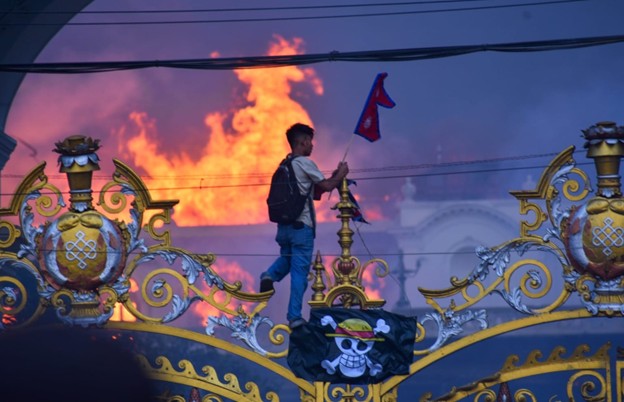
A protester carrying a Nepalese flag hangs a pirate flag as smoke and flames rise from the Singha Durbar, the seat of Nepal’s government, in Kathmandu, Nepal, on September 9, 2025.
Bangladesh (2024), underscoring the fragility of small South Asian democracies and raising far-reaching questions about the future of free speech and digital expression in Asia.²
For many young people, social media is no longer optional—it is how they study, communicate, express dissent, call out corruption, and organise. The ban felt, for them, like silencing rather than safeguarding.
These events have reopened urgent questions: What legal authority did the government have to impose such blocks? Were the restrictions proportionate? What constitutional safeguards exist in Nepal for freedom of expression, especially when digital platforms are primary spaces of dissent for young people? And finally, what lines should be drawn to ensure state regulation does not slide into oppression?
The Gen-Z Protests & Digital Censorship: What Happened
On 4 September 2025, the Nepal government announced a ban on 26 social media platforms including Facebook, Instagram, X, WhatsApp, YouTube, Reddit and others for failing to register locally and appoint liaison or compliance officers under proposed regulation rules.³ The law was still under debate; the Social Media Bill cited had not passed Parliament at that date. The government’s justification: to combat misinformation, mandate accountability, ensure platforms respect local laws. Protesters interpreted it as censorship — suppression of dissent, especially given broader grievances over corruption and lack of accountability.
Mass protests erupted. On September 8 thousands of young Gen Z demonstrators, many in school and university uniforms, gathered in central Kathmandu near the Maitighar Mandala monument and the federal parliament.⁴ The protests began peacefully but turned violent after security barricades were breached. Police responded with tear gas, water cannons, rubber bullets, and eventually live ammunition. At least nineteen people were killed in Kathmandu and other cities. IFJ reported 4 journalists injured; media outlets warned that press freedom was at risk.
Unrest spread quickly as protesters set fire to parliament building, government offices, police stations, and the residences of politicians on September 9. The homes of Oli and former prime minister Jhalanath Khanal were among those targeted; Khanal’s wife, Ravi Laxmi Chitrakar, suffered severe burn injuries. Prime Minister KP Sharma Oli had resigned.⁵ Following the visceral backlash, the government lifted the social media ban⁶, but protests continued until the army imposed a nationwide curfew on September 10.
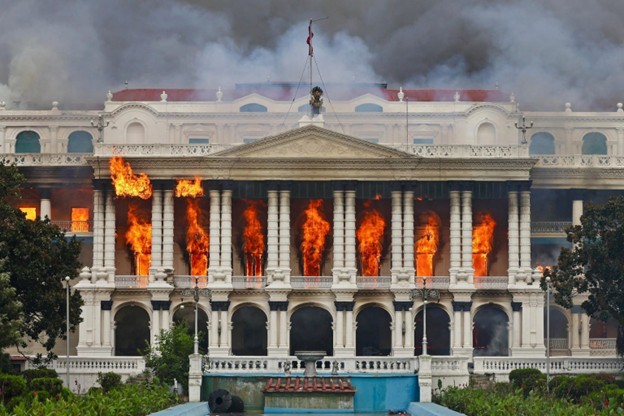
| Nepal’s central administrative complex, Singha Durbar, burning after protesters set multiple government buildings ablaze during the country’s September 2025 unrest, Kathmandu. |
As of September 14 the violence had left 72 dead and more than 2,113 injured. The army emerged as the country’s last stable institution capable of negotiating with protest leaders and conferring legitimacy on any new government.
In an ironic turn, the very tool the state sought to silence—social media—emerged as the central arena for reimagining Nepal’s political future. Over 145,000 citizens gathered in a Discord server that journalists dubbed a new “national convention,” with many participants claiming it had, in practice, replaced parliament itself. By 10 September, the digital assembly had rallied around Sushila Karki, the nation’s first female chief justice, nominating her as interim prime minister.⁷ Following consultations with the military, the proposal was conveyed to the president, who formally swore Karki into office on 12 September, making her Nepal’s first woman leader. On 15 September, she announced her inaugural cabinet—populated by reform-minded figures—signalling her intent to pursue transparency and restore public confidence in governance.
These events, while focusing on digital censorship, also brought to light how offline state repression and online regulation are deeply entwined. The youth saw platforms not merely as tools of communication but as lifelines of expression, dissent, and community. When those lifelines were cut, it felt personal.
Legal & Constitutional Framework in Nepal
Freedom of Expression Under Nepal’s Constitution
Nepal’s Constitution guarantees right to freedom of opinion and expression under Article 17 and also guarantees freedom to seek, receive, and impart information through any medium under Article 19(1).⁸ But, like many constitutional schemes, this right is not absolute. The Constitution itself allows reasonable restrictions under Article 17(2) in the name of public decency, morality, national security, defamation, incitement to violence, communal harmony, etc.⁹
In February 2025, Nepal’s Supreme Court held in a case challenging the Electronic Transactions Act, 2006, that freedom of expression is fundamental, but “not unlimited”.¹⁰ The Court upheld Section 47 of the act, which imposes fines or imprisonment for publishing or displaying prohibited content (e.g. material in electronic media that is “contrary to public morality,” or that incites discord), on the basis that restrictions, if reasonable and constitutional, are permissible.¹¹
The Social Media Bill & Regulatory Proposals
The government has introduced the draft Operation, Use, and Regulation of Social Media Bill (2025) which includes registration requirements for platforms, appointment of grievance officers, requirements to pay taxes/local registration, penalties for non-compliance, and obligations to moderate “misleading content” or content that is harmful to public decency or social harmony.¹²
Though some registration obligations were upheld by Supreme Court rulings (e.g., requiring platforms to register or face consequences) in earlier writs,¹³ the legal danger lies in vague terms in the bills (e.g. “misleading content,” “social harmony,” “public decency”) without precise definitions, leading to potential overreach.
Judicial Precedent: Reasonable Restriction
Nepal’s courts have already recognized that rights including expression are subject to reasonable restriction under constitutional limits. For example, in the case brought by advocate Pratyush Nath Upreti challenging Section 47 of the Electronic Transactions Act, 2006, the Constitutional Bench held that such restrictions do not violate the Constitution as long as they fall within the bounds the Constitution allows.¹⁴
Thus, Nepal’s legal framework provides for some regulatory oversight, but also embeds constraints meant to prevent misuse. The tension is whether the recent bans and proposed regulation crossed beyond what is “reasonable” and proportional.
The National Human Rights Commission (NHRC) has repeatedly emphasised both the right to peaceful dissent and the obligation of the State to use force in ways consistent with constitutional and international human rights norms.¹⁵
International Law
Nepal is a party to the International Covenant on Civil and Political Rights (ICCPR), under which Article 19 protects freedom of expression, subject to certain restrictions that are provided by law, necessary, and proportionate.¹⁶ The UN Human Rights Committee jurisprudence requires limitations to be clearly defined, non-arbitrary, serving a legitimate aim, and necessary in a democratic society.¹⁷
In the policing of protests, norms such as the UN Basic Principles on the Use of Force and Firearms by Law Enforcement Officials impose strict constraints on when and how force—and especially lethal force—can be used.¹⁸
State Justifications vs. Rights-Based Critique
Government’s Justifications
From the government’s perspective:
- Platforms were required to register locally and designate offices. Non-compliance triggered action.¹⁹
- Authorities claimed misinformation was spreading via unregulated platforms.
- PM Oli declared that “any attempt to undermine the nation cannot be tolerated”.²⁰
Critique from Rights Perspective
- Banning dozens of platforms overnight, shutting off youth’s primary means of communication, seems disproportionate given less restrictive alternatives (warnings, temporary takedowns, content removal).
- The regulation and the ban were implemented before full parliamentary debate or clarity; vague definitions make compliance difficult; no mechanisms to appeal or challenge decisions reliably.
- When youth see platforms blocked, journalists intimidated, or content removed, many self-censor rather than risk reprisal.
- Young people, students, rural users are disproportionately impacted—those lacking VPNs, alternative platforms, or digital literacy.
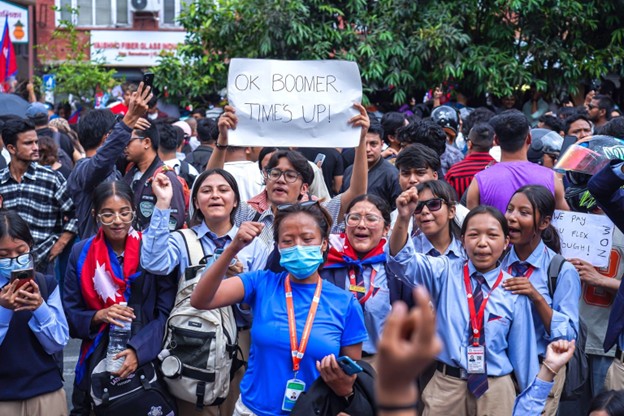
| Young protesters demonstrate against corruption and the ban on social-media platforms by the government in Kathmandu, Nepal, on September 8, 2025. |
Legal Analysis: Boundaries of State Action vs. Expression
The Social Media Ban: Censorship in Digital Garb
The ban on 26 platforms is a form of prior restraint of expression—blocking platforms from being accessed at all. Even though the State may regulate content, remove material later, or require registration, prohibiting entire platforms pre-emptively is heavy: it suppresses lawful expression along with any allegedly unlawful speech.
Legally, under Nepal’s constitution, prior restraints are generally disfavoured unless the law explicitly allows them under Section 17(2) in narrow circumstances. The Supreme Court’s interpretation in Government can enforce law to regulate free speech underlines that restrictions must be not only “reasonable” but also specific, and cannot erode the core of expression rights.²¹
Additionally, International Human Rights Law(IHRL) insists that broad censorship is justified only in rare emergencies. The State must show that the restriction is necessary, proportionate, and there is no less restrictive means. In Nepal’s scenario, the speed and breadth of the ban suggest a lack of incremental approach or sufficient safeguards.
Protest Suppression and Use of Force
Peaceful protest is a protected exercise of freedom of assembly and expression.²² Even when protests become tense, police action must follow legal, constitutional, and human rights norms: warnings, selective use of force, least harmful means first.²³
The Supreme Court of Nepal have recognized obligations to criminalize torture and to ensure dignity for persons in custody. In the case of Rajendra Ghimire v Prime Minister & Office of the Council of Ministers and others, the Court directed the government to criminalise torture, stating “The state should behave with high dignity and high ethics for those who are in custody.”
However, here, reports by Human Rights Watch and Amnesty suggest police used live ammunition, killed protesters where other means might have sufficed, which would violate both Nepal’s obligations under its Constitution and international norms.²⁴ The NHRC also condemned the excessive force and urged restraint.²⁵
Were Constitutional & Human Rights Boundaries Breached?
Freedom of Expression / Digital Speech
The ban appears to violate the constitutional guarantee of free expression, particularly given its overbreadth and the lack of transparency.²⁶ The law allows restrictions, but not blanket prohibitions without due process.²⁷ The registration directive might be lawful in part, but the immediate banning for non-compliance, without perhaps opportunity for notice, appeal, or accommodating delay, is legally suspect.
Right to Peaceful Assembly and Protest
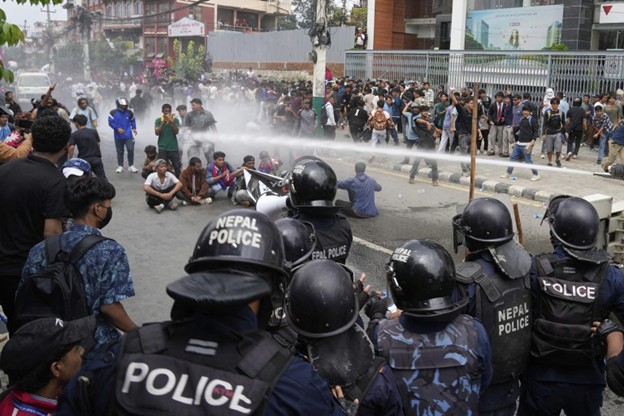
| Riot police use a water cannon on protesters outside Parliament in Kathmandu on September 8, 2025. |
Protest is a fundamental democratic right. The State must avoid infringing that unless necessary.²⁸ The deaths and injuries during the protests, especially through the use of lethal force, raise serious concerns of constitutional and international law violations. If State forces used live weapons to disperse protests not posing an imminent danger of death or serious harm, that is unlawful.²⁹
Procedural Safeguards and Accountability
The law mandates that restrictions be “provided by law” and meet certain clarity.³⁰ In addition, for use of force, there is expectation of independent investigation, remedy, compensation.³¹ The lack of transparency over investigations and limited accountability weakens the legitimacy of the State’s response.
Comparative Analogies
India has seen similar recent incidents: states or central government imposed social media shutdowns during protests or unrest. Indian jurisprudence has generally held that such shutdowns must satisfy criteria of necessity, be time-bound, and have judicial or independent oversight.³²
In Hong Kong, protestors’ use of social media and online tools was central; government attempts to regulate content drew both domestic and international criticism. The courts frequently intervened to protect speech rights under constitutional guarantees.³³
In Iran, the government has repeatedly shut down internet access or social media platforms during protests. International human rights law has criticized the lack of proportionality and the broad nature of restrictions (which cut off essential communications, medical information, etc.).³⁴
These comparisons show a common pattern: states often claim regulation or public order; the human rights lens demands clarity, judicial oversight, and that restrictions be narrowly tailored and temporary.
Legal Boundaries: What Is Permissible Under Law?
As per the Nepalese constitutional and legal framework and comparative practice,
- Any law or regulation must be valid under constitutional powers, and terms must be defined clearly enough for citizens to know what is allowed vs. prohibited.³⁵
- The means used (e.g., blocking platforms, imposing curfews) must be proportionate to the aim (e.g., national security, preventing misinformation), and the least restrictive available.³⁶
- Restrictions should be for a limited time and lifted when no longer necessary. The temporary ban in Nepal was lifted following protests, demonstrating the potential for reversibility.³⁷
- Affected platforms/users should have ability to challenge decisions; oversight (judicial or independent) should be in place; regulation should follow transparent process.³⁸
- Political speech, dissent, artistic expression, protest speech deserves high protection. Laws regulating speech must be especially careful not to clamp down on criticism.³⁹
- When harms occur—deaths, injuries, violations—there must be investigations, compensation, and consequences.⁴⁰
Hearts, Voices, and Justice: The Youth Factor
The Gen-Z generation in Nepal, digitally connected and socially aware, views digital spaces not simply as entertainment but as vital public squares. Blocking them is experienced as silencing. Young people used platforms to document corruption, mobilize, express dissent. The ban disrupted jobs of small creators, hampered education via WhatsApp or YouTube, and severed communication channels. Social media is not abstraction: for many, it was how they stayed connected; for others, it was a source of learning, livelihood, community. Blocking access was blocking lifelines.
When bullets, rubber or live, tear gas and water cannon confront them in the streets, the stakes are lives. Families grieve; trust in institutions fractures. The State, in its attempt to assert order, risks suppressing not only dissent but the dignity of those it governs. A youthful generation rising up demands more than lip service—they demand constitutional respect, human rights in practice, not only in promise.
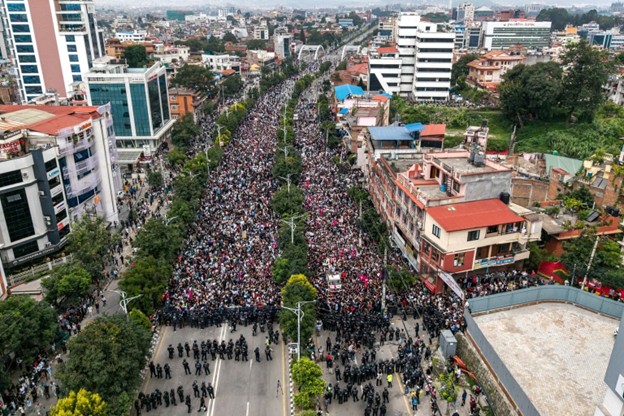
| An aerial view shows demonstrators gathered outside Nepal’s Parliament during a protest in Kathmandu on September 8, 2025, condemning government social-media prohibitions and corruption. Nepal police opened fire, killing at least 19 people as thousands of young protesters demonstrated on September 8. |
Democracy depends not only on institutions but on trust. When trust is broken by unannounced bans or violence, civic relationships suffer. Youth involvement, protest, dissent—these are often the early indicators of a society asking for reform. The law must listen.
Conclusion
The Gen-Z protests in Nepal were more than a reaction to social media bans. They were a reflection of accumulated frustration — corruption, lack of opportunity, and a feeling that state power was unresponsive. When the government cut off social media access, it struck at the heart of youth’s modes of expression and organization.
Legally, Nepal has a constitutional guarantee of expression, but this guarantee has always been balanced with restrictions. What matters now is whether these restrictions are applied justly, proportionately, with clarity, and with accountability. If regulation is to keep societies safe and well-ordered, it must never become the tool of shutting down dissent or silencing the vulnerable.
Nepal stands at a critical junction. There is an opportunity to build laws and policies that respect digital speech without descending into censorship; that protect youth voices; that ensure state accountability. Because democracy is not just about elections — it is about voices being heard, ideas being shared, critiques being voiced. In the digital age, to silence social media platforms is to silence people’s stories too. The legal boundaries of state power must be respected, but even more, the state must respect the boundaries of youth, dissent, and expression — for that is how democracy matures.
Reference List
Primary Sources
Legislation & Constitutional Instruments
- Constitution of Nepal 2015 (2072 BS).
- Electronic Transactions Act 2063 (2006) (Nepal).
- Social Media Management Directive 2080 (2023) (Nepal).
- Social Media Act (Bill) 2081 (2025) (Nepal).
Cases
- Anuradha Bhasin v Union of India (2020) 3 SCC 637 (India).
- Pratyush Nath Upreti v Government of Nepal [2025] (Supreme Court of Nepal, Constitutional Bench).
- HKSAR v Chung Man (2024) (Hong Kong)
International Instruments
- International Covenant on Civil and Political Rights (adopted 16 December 1966, entered into force 23 March 1976) 999 UNTS 171.
- UN Human Rights Committee, General Comment No 34: Article 19, Freedoms of Opinion and Expression (12 September 2011) UN Doc CCPR/C/GC/34.
- UN Human Rights Committee, General Comment No 31: Nature of the General Legal Obligation Imposed on States Parties to the Covenant (26 May 2004) UN Doc CCPR/C/21/Rev.1/Add.13.
- UN General Assembly, Basic Principles on the Use of Force and Firearms by Law Enforcement Officials (adopted 7 September 1990, Eighth UN Congress on the Prevention of Crime and the Treatment of Offenders, Havana) UN Doc A/CONF.144/28/Rev.1.
Reports (Institutional)
- National Human Rights Commission, Annual Report 2022/23 (Kathmandu, NHRC 2023).
Secondary Sources
News & Commentary
- Al Jazeera, ‘Nepal, Bangladesh, Sri Lanka: Is South Asia fertile for Gen Z revolutions? Protests’ (16 September 2025) https://aje.io/vts5oo
- Al Jazeera, ‘Nepal lifts social media ban after 19 killed in protests against corruption’ (9 September 2025) https://aje.io/5grgsz
- Amnesty International, ‘Nepal: Accountability needed following deadly crackdown on “Gen Z” protesters’ (9 September 2025) https://www.amnesty.org/en/latest/news/2025/09/nepal-accountability-for-deadly-crackdown-on-gen-z-protesters/
- Amnesty International, ‘Iran: Internet deliberately shut down during November 2019 killings – new investigation’ (2020) https://www.amnesty.org/en/latest/press-release/2020/11/iran-internet-deliberately-shut-down-during-november-2019-killings-new-investigation/ Associated Press, ‘Nepal blocks Facebook, X, YouTube and others for failing to register with the government’ (5 September 2025) https://apnews.com/article/3b42bbbd07bc9b97acb4df09d42029d5
- BBC News, ‘Nepal parliament set on fire after PM resigns over anti-corruption protests’ (9 September 2025) https://share.google/SMGTwXYN79pBUOv61
- Free Press Journal, ‘“Nation being undermined cannot be tolerated,” Says Nepal PM KP Sharma Oli on Social Media Ban’ (7 September 2025) https://www.freepressjournal.in/world/nation-being-undermined-cannot-be-tolerated-says-nepal-pm-kp-sharma-oli-on-social-media-ban
- Hindustan Times, ‘Access to internet is a fundamental right, says Supreme Court’ (24 August 2020) https://www.hindustantimes.com/india-news/access-to-internet-is-a-fundamental-right-says-supreme-court/story-miomQARGJTy7Cz1WPazENI.html
- Human Rights Watch, ‘Nepal: Police Fire on “Gen Z” Protest’ (9 September 2025) https://www.hrw.org/news/2025/09/09/nepal-police-fire-on-gen-z-protest
- Human Rights Watch, ‘“No Internet Means No Work, No Pay, No Food”: Internet Shutdowns Deny Basic Rights in “Digital India”’ (14 June 2023) https://www.hrw.org/report/2023/06/14/no-internet-means-no-work-no-pay-no-food/internet-shutdowns-deny-access-basic
- Independent, ‘How Gen Z protestors chose Nepal’s first woman prime minister on Discord’ (15 September 2025) https://www.independent.co.uk/asia/south-asia/nepal-sushila-karki-new-prime-minister-discord-protests-b2826473.html
- My Republica, ‘Fundamental rights are not unlimited: Supreme Court’ (23 February 2025) https://myrepublica.nagariknetwork.com/news/fundamental-rights-are-not-unlimited-supreme-court-37-74.html
- Nepali Times, ‘Protest grows against Nepal’s social media ban’ (5 September 2025) https://nepalitimes.com/news/protest-grows-against-nepal-social-media-ban South China Morning Post, ‘Hong Kong protests: judge urges social media users to “reflect” on online speech as he jails man …’ (4 December 2021) https://www.scmp.com/news/hong-kong/law-and-crime/article/3158161/hong-kong-protests-judge-urges-social-media-users
- The Hindu, ‘Internet disrupted in Iran amid fuel protests in multiple cities’ (16 November 2019) https://www.thehindu.com/sci-tech/technology/internet-dead-in-iran-maha-ami-protests-targeted-by-shutdown-instagram-whatsapp/article65949809.ece The Kathmandu Post, ‘Government can enforce law to regulate free speech, top court rules’ (19 February 2025) https://kathmandupost.com/national/2025/02/19/government-can-enforce-law-to-regulate-free-speech-top-court-rules
- The Kathmandu Post, ‘Top Court Says All Social Media, Online Sites Must Register’ (17 August 2025) https://kathmandupost.com/national/2025/08/17/top-court-says-all-social-media-online-sites-must-register
- [Nepal] National Human Rights Commission, ‘NHRC urges restraint as 14 dead in Gen Z protests’ The Kathmandu Post (8 September 2025) https://kathmandupost.com/national/2025/09/08/national-human-rights-commission-urges-restraint-as-14-dead-in-gen-z-protests
One Response